Unraveling the Ladakh Conundrum: A Deep Dive into Historical, Geopolitical, and Socio-Economic Perspectives
Unraveling the Ladakh Conundrum: A Deep Dive into Historical, Geopolitical, and Socio-Economic Perspectives


It is a region administered by India as a union territory, and is located in the larger Kashmir region. It borders Tibet, Himachal Pradesh, Jammu and Kashmir, and China. Ladakh holds strategic importance, historically serving as a trade hub. Leh and Kargil are the largest towns, with diverse religious groups including Muslims, Buddhists, and Hindus. Established as a union territory in 2019, Ladakh is sparsely populated and shares cultural ties with Tibet. It is estimated that more than 90% of Ladakh’s population is tribal. The primary Scheduled Tribes (STs) in Ladakh are Balti Beda, Bot (or Boto), Brokpa (or Drokpa, Dard, Shin), Changpa, Garra, Mon and Purigpa
Demands of Ladakh:
- Statehood for Ladakh: Seeking to elevate Ladakh from its current Union Territory status to a full-fledged state, granting it greater political autonomy and decision-making powers
- Reservation of Jobs: The Ladakh administration responded to youth demands by increasing ST reservation in direct recruitment from 10% to 45% in 2023
- Creation of Separate Parliamentary Constituencies: Demanding the establishment of distinct Parliamentary constituencies for Leh and Kargil, reflecting the unique demographic and geographical characteristics of each region
- Ladakh’s demand for the 6th Schedule: Last year, in 2023, a high-powered committee was formed in Ladakh to address growing demands for its inclusion under the Sixth Schedule. Civil society groups seek protection of land, resources, and employment after Article 370’s revocation.
- The National Commission for Scheduled Tribes had previously recommended Ladakh’s inclusion in the Sixth Schedule due to its tribal majority and unique cultural heritage.

The Sixth Schedule, outlined in Article 244, establishes autonomous administrative divisions known as Autonomous District Councils (ADCs) within certain states. Currently, it applies to tribal areas in Assam, Meghalaya, Tripura, and Mizoram. Each autonomous district has a council with legislative, judicial, and administrative powers, including lawmaking on various matters such as land, forests, and village administration. The governor organizes these districts, appointing some council members while others are elected. The councils can also manage local infrastructure and collect revenue
Ladakh's historical connections with India, Tibet, and China.

- Dogras invasion: Historically, Ladakh was an independent kingdom from about A.D. 950 until 1834, when Hindu Dogras (from Jammu, which is southwest of Ladakh) invaded it.
- The Sikhs acquired Kashmir in 1819, Emperor Ranjit Singh turned his ambition towards Ladakh. But it was Gulab Singh, the Dogra feudatory of the Sikhs in Jammu, who went ahead with the task of integrating Ladakh into Jammu and Kashmir.
- Tibet invasion: In May 1841, Tibet under the Qing dynasty of China invaded Ladakh with the hope of adding it to the imperial Chinese dominions, leading to the Sino-Sikh war.
- However, the Sino-Tibetan army was defeated, and the ‘Treaty of Chushul’ was signed that agreed on no further transgressions or interference in the other country’s frontiers.
- British suzerainty: After the first Anglo-Sikh war of 1845-46, the state of Jammu and Kashmir, including Ladakh, was taken out of the Sikh empire and brought under British suzerainty.
- As a buffer zone: The state of Jammu and Kashmir was essentially a British creation, formed as a buffer zone where they could meet the Russians.
- Consequently, there was an attempt to delimit what exactly was Ladakh and the extent of the state of Jammu and Kashmir, but it became convoluted since that area came under Tibetan and Central Asian influence.
- Pakistan and China border dispute: Ladakh became a contested territory between the newly independent nations of India and Pakistan. In the early 1960’s a substantial area of eastern Ladakh was annexed by China.
- Due to increasing tensions between India and Pakistan, the Chinese invasion of Tibet in the 1950s, and their occupation of the Aksai Chin region in 1962, Ladakh has become one of India’s most important strategic zones.
- Strategic location and border disputes with Pakistan and China have assured a firm foothold for army presence since the past 50 years
Geopolitical Dynamics

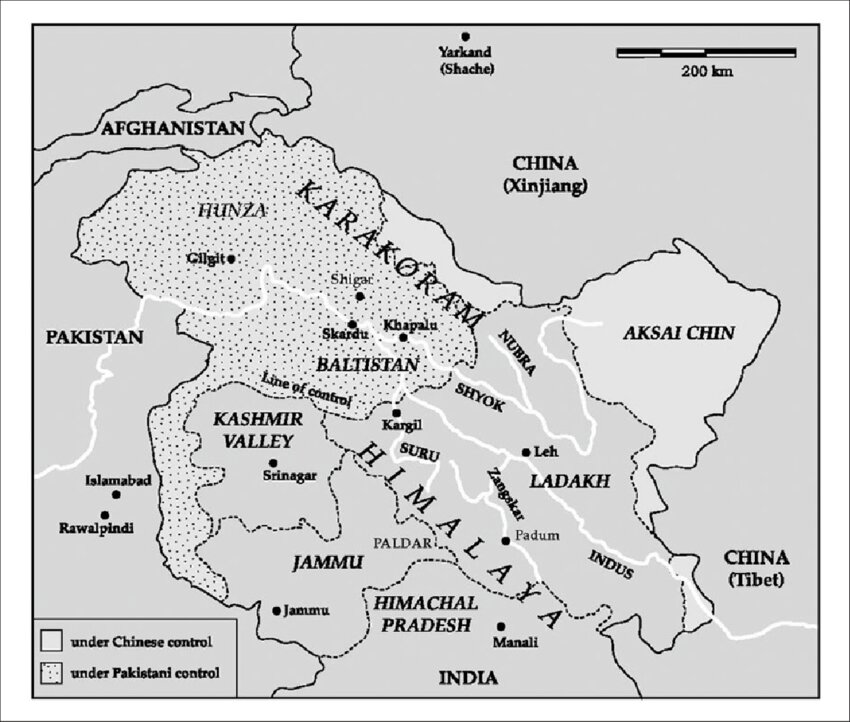
- Bordering regions: It is bordered by the Chinese Tibet Autonomous Region to the east, the Indian state of Himachal Pradesh to the south, both the Indian union territory of Jammu and Kashmir and the Pakistan-administered Gilgit-Baltistan to the west, and the southwest corner of Xinjiang across the Karakoram Pass in the far north.
- River system: The Indus River and its major tributaries, the Shyok-Nubra, Chang Chenmo, Hanle, Zanskar, and Suru-dras rivers, drain the region. Glacio-fluvial processes aided by freeze- thaw weathering have formed the high altitude landscape of Ladakh.
- Climate: Ladakh has an extremely harsh environment and one of the highest and driest inhabited places on earth. Ladakh’s climate is referred to as a “cold desert” climate due to its combined features of arctic and desert climates.
- The entire area is nearly devoid of vegetation with the exception of valley floors and irrigated areas, due to the following factors:
- These include wide diurnal and seasonal fluctuations in temperature, from -40°C in winter to +35°C in summer, and extremely low precipitation, with an annual 10 cm to 30 cm primarily from snow.
- Due to high altitude and low humidity, the radiation level is amongst the highest in the world.
- The entire area is nearly devoid of vegetation with the exception of valley floors and irrigated areas, due to the following factors:
- Soil type: In Ladakh soils range from gravely and sandy loams on the alluvial fans to sandy and silt clay loams on the flood plains of Indus. Ladakh’s soil is described as skeletal, calcareous with an alkaline reaction.
- By and large, soil is coarse and sandy, having varying quantities of pebbles. The soils are characterized by low organic matter content and poor water retention capacity
India-China relations

Ladakh to both India and China is rooted in complicated historical processes that led to the territory becoming union territory in 2019 (earlier it was part of the state of Jammu and Kashmir), and China’s interest in it post the occupation of Tibet in 1950.
- Rich in natural resources: Ladakh is situated within the upper reaches of the Indus watershed, which in total supports about 120 million people in India (in the states of Haryana, Himachal Pradesh, Jammu & Kashmir, Punjab and Rajasthan) and about 93 million in the Pakistan province of the Punjab (literally, “Land of the Five Rivers”).
- Careful management of water resources within Ladakh is therefore vitally important, not only for the livelihoods of Ladakhis and the ecosystems of Ladakh, but for the health of the whole river system.
- Solar radiation: It is one of the most abundant natural resources in Ladakh, with annual solar radiation exceeding averages for other areas of India with high insulation.
- Geothermal potential: surveys have identified a geothermal resource at depths suitable for exploration and development.
- This resource could be developed to provide grid connected power to small settlements and army bases sited on the national highway.
- Tourism industry: Popularly known as the Lama Land or little Tibet, Ladakh lies at altitudes ranging between about 9,000 feet and 25,170 feet. From trekking and mountaineering to Buddhist tours of various monasteries, Ladakh has it all.
- Provides connectivity: The passes of Ladakh region connect some of the politically and economically significant zones of the world like Central Asia, South Asia, China and the Middle East.
- Market access: The south Asian countries can reach Central Asian markets through this region. Countries like Uzbekistan, Turkmenistan and Kazakhstan are rich in uranium, cotton, oil and gas resources.
- Energy security: In future, the oil and gas pipeline from Iran to China can pass through this mountainous corridor. India‟s energy needs can also be met by constructing a pipeline from Central Asia via this region.
Other Significance
- Geopolitical Significance: The land of Ladakh enjoys the significance of being located at the ancient Silk Route which passes through these regions and played a very vital role in the development of culture, religion, philosophy, trade and commerce in the past.
- Geostrategic location: The presence of resources is what makes India, China and Pakistan struggle over Ladakh, in order to gain control over resources in this region. Pakistan and China are in conflict with India over Siachen and Aksai chin in this region. Ladakh’s geostrategic significance has increased in the backdrop of these conflicts.
India-China Border Dispute
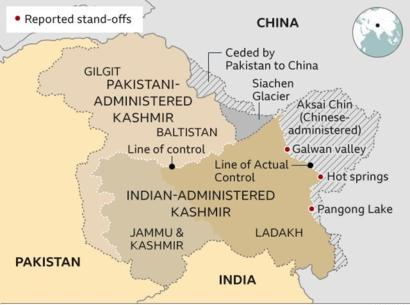
- The origins of this contention date back to the British Raj which failed to demarcate the border between its colony and China definitively.
- Recently, Indian and Chinese armies are engaged in the standoff in Pangong Tso, Galwan Valley, Demchok and Daulat Beg Oldie in eastern Ladakh.
- The Galwan Valley area comes under Sub Sector North (SSN), which lies just to the east of the Siachen glacier and is the only point that provides direct access to Aksai Chin from India.
- Both countries are rising nations which share a 3800 kilometre long border of which a large part remains disputed.
- By and large, today‟s border issue revolves around two main boundary designs that have been put forward by the British.
- India continues to maintain the McMahon Line as the legal border, while China has never accepted the border, stating that Tibet was never independent.
- In 1962, Chinese troops crossed the McMahon line and, after war, China pushed forward to establish a "Line of Actual Control".
- However, none of these boundaries had ever been anchored in a binding bilateral treaty. And so, the status of the Indo-Chinese border in the western section at the time of Indian independence remained unsolved.
- By and large, today‟s border issue revolves around two main boundary designs that have been put forward by the British.
Line of Actual Control (LAC)
- The LAC is the demarcation that separates Indian-controlled territory from Chinese-controlled territory. India considers the LAC to be 3,488 km long, while the Chinese consider it to be only around 2,000 km.
- The India-China LAC in Ladakh is an outcome of the territory illegally retained by China after the 1962 conflict. The Chinese occupation of parts of Aksai Chin is not supported by historical or legal documents.
- It is divided into three sectors:
- the eastern sector which spans Arunachal Pradesh and Sikkim
- the middle sector in Uttarakhand and Himachal Pradesh
- the western sector in Ladakh
- Ladakh has the potential to act as a vessel to feed India its required energy resources. For this peace in Ladakh is a condition. For peace, equal unbiased development is mandatory.
- Therefore, India’s policymakers, while drafting their policies for Ladakh, should consider its geographic location, fragile environment, resource potentials and its people’s aspirations. In such a strategic location, it is crucial to keep all these aspects in harmony to take advantage of it to its fullest.
What Makes Ladakh Significant for India?
- Geopolitical Importance: Ladakh is also known as “the Land of Passes‟ (La-passes, dakh-land). Ladakh's strategic location at the crossroads of South Asia, Central Asia, and East Asia gives it immense geopolitical significance.
- Strategic Significance: It serves as a buffer zone between India and its neighboring countries, including China and Pakistan. The ongoing border disputes with China and Pakistan in the Ladakh region underscore its importance in safeguarding India's territorial integrity and sovereignty.
- The Indian Armed Forces maintain a strong presence in Ladakh to counter external threats and safeguard India's borders.
- Tourism Potential: Popularly known as the Lama Land or Little Tibet, Ladakh lies at altitudes ranging between about 9,000 feet and 25,170 feet. From trekking and mountaineering to Buddhist tours of various monasteries, Ladakh has it all.
- Economic Importance: Ladakh possesses vast untapped economic potential, particularly in sectors such as tourism, agriculture, and renewable energy.
- The region's breathtaking landscapes, including the pristine lakes and majestic mountains of Pangong and Tso Moriri, attract tourists seeking adventure and tranquility.
- Environmental Significance: Ladakh's fertile valleys and river basins offer opportunities for agricultural development, including organic farming and horticulture. Additionally, Ladakh's abundant sunlight and wind resources make it conducive for the development of solar and wind energy projects, contributing to India's renewable energy goals.
- Cultural Significance: The land of Ladakh enjoys the significance of being located at the ancient Silk Route which passes through these regions and played a very vital role in the development of culture, religion, philosophy, trade, and commerce in the past.
- The region is home to diverse ethnic communities, including the Ladakhi, Tibetan, and Balti people, each with their distinct traditions and customs.
- The centuries-old monasteries of Hemis, Thiksey, and Diskit serve as spiritual and cultural centers, preserving ancient Buddhist teachings and practices.
- The region is home to diverse ethnic communities, including the Ladakhi, Tibetan, and Balti people, each with their distinct traditions and customs.

What are the Arguments in Favour of Ladakh's Demand for Inclusion in the 6th Schedule

- Ensuring Representation: Following the reorganization of Jammu and Kashmir in 2019, Ladakh was designated as a Union Territory without a legislative assembly. This change led to concerns about the loss of local autonomy and representation in decision-making processes.
- This has led to comparisons with the earlier situation where Ladakh had four members in J&K’s assembly and two in the legislative council.
- When Ladakh was part of erstwhile Jammu and Kashmir, the Ladakh Autonomous Hill Development Council (LAHDC), an elected body that governed the region, enjoyed significant autonomy.
- But with the region now under the direct rule of the central government, Ladakhi leaders say the LAHDC has been reduced to footnotes, leading to a feeling of political dispossession.
- Diminished representation now has led to fears that outsiders will decide for Ladakh.
- Lack of Public Participation: As part of the State of Jammu and Kashmir, Ladakh had enjoyed privileges of special status under Article 370 and Article 35A. The sentiment now is one of disempowerment, as the absence of safeguards for jobs, land, culture, and identity has led to growing insecurity. The lack of a legislative body means that decision-making has shifted from public participation to bureaucratic processes.
- Ladakh’s Fragile ecosystem: Ladakh's fragile ecosystem, characterized by high-altitude deserts, glaciers, and alpine meadows, is a hotspot of biodiversity and serves as a crucial habitat for rare and endangered species.
- Climate activists have flagged concerns regarding mining in the glacial ecology.
- People in Ladakh fear that if there are industries, each industry will bring lakhs of people and this fragile ecosystem cannot support so many people.
- Careful management of water resources within Ladakh is therefore vitally important, not only for the livelihoods of Ladakhis and the ecosystems of Ladakh but for the health of the whole river system,
- Sensitive Borders: The delicate situation in Ladakh is compounded by its borders with both China and Pakistan. The ongoing military standoff with the Chinese PLA in eastern Ladakh, combined with Pakistan's persistent efforts to stoke tensions in India's border areas, presents a significant security challenge.
- Preservation of Cultural Identity: Inclusion in the Sixth Schedule would provide legal safeguards to protect Ladakh's unique cultural heritage and traditional customs. The Sixth Schedule empowers tribal communities with a degree of autonomy in governance, enabling them to manage their own affairs and resources.
- Performance of Socio-Economic Development: Critics argue that the performance of the Union Territory administration has been notably deficient in terms of generating employment opportunities for the young workforce.
- Four years have passed since the establishment of the Union Territory, but the absence of a public service commission has created a sense of anger among the youths.
- A glaring issue compounds this situation—the lack of a comprehensive job policy within the Union Territory.
- The autonomy granted under the Sixth Schedule can facilitate the formulation and implementation of locally relevant development initiatives, leading to improved socio-economic outcomes.
- Strengthening of Democratic Institutions: The establishment of autonomous councils under the Sixth Schedule would strengthen democratic institutions at the grassroots level, promoting inclusive governance and accountability.
What is the Sixth Schedule?
- Article 244: The Sixth Schedule under Article 244 provides for the formation of autonomous administrative divisions — Autonomous District Councils (ADCs) — that have some legislative, judicial, and administrative autonomy within a state.
- Current Status : The Sixth Schedule contains special provisions for the administration of tribal areas in the four north-eastern states of Assam, Meghalaya, Tripura and Mizoram.
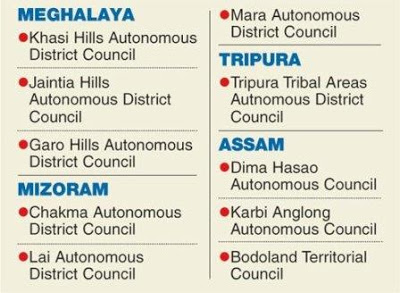
- Autonomous Districts: The tribal areas in these four states have been constituted as autonomous districts. The governor is empowered to organize and reorganize the autonomous districts.
- District Council: Each autonomous district has a district council consisting of 30 members, of whom four are nominated by the Governor and the remaining 26 are elected on the basis of adult franchise.
- Powers of the Council: The district and regional councils administer the areas under their jurisdiction.
- They can make laws on certain specified matters like land, forests, canal water, shifting cultivation, village administration, the inheritance of property, marriage and divorce, social customs and so on. But all such laws require the assent of the Governor.
- They can constitute village councils or courts for trial of suits and cases between the tribes. They hear appeals from them. The jurisdiction of the high court over these suits and cases is specified by the governor.
- The district council can establish, construct or manage primary schools, dispensaries, markets, ferries, fisheries, roads and so on in the district.
- They are empowered to assess and collect land revenue and to impose certain specified taxes
What are the Arguments Against Inclusion of Ladakh in the Sixth Schedule?
- Legal and Administrative Hurdles: The Ministry of Home Affairs has highlighted potential challenges in amending the Constitution to include Ladakh in the Sixth Schedule, stating that such a move would require a constitutional amendment.
- Potential Delays in Decision-Making: Some may argue that including Ladakh in the Sixth Schedule could add complexity to the region's governance structure, potentially leading to administrative challenges and delays in decision-making processes.
- Inclusion Already Under Progress: The central government informed a parliamentary standing committee recently that the objective for inclusion of tribal population under the sixth schedule is to ensure their overall socio-economic development, which the UT administration has already been taking care of and that sufficient funds are being provided to Ladakh to meet its overall developmental requirements.
- Increased Reservations: According to a recent report tabled in Rajya Sabha, the Ladakh administration recently increased the reservation for the Scheduled Tribes in direct recruitment from 10% to 45% which will significantly help the tribal population in their development.
- Hinderence in Economic Development: Being a Union Territory allows for focused investment in infrastructure development in Ladakh, including roads, airstrips, and communication networks. Critics argue that inclusion in the Sixth Schedule could hinder Ladakh's economic development by imposing restrictions on land use, resource exploitation, and investment opportunities.
- Clear Chain of Command: With Ladakh directly governed by a Lieutenant Governor appointed by the central government, there is a clear chain of command for security operations in the region. This facilitates effective coordination between the military, paramilitary forces, and local administration in responding to Chinese incursions.
- Ladakh's status as a Union Territory reinforces India's sovereignty over the region, strengthening its diplomatic position in negotiations with China over border disputes.
What Should be the Way Forward?
- Meaningful Dialogue: The government should initiate meaningful dialogue with the stakeholders involved in the protests, including representatives from Ladakh's local communities, political leaders, and civil society organizations.
- This dialogue should aim to understand the underlying grievances, aspirations, and concerns driving the demand for Sixth Schedule status.
- Assessment of Feasibility: A thorough assessment should be conducted to evaluate the feasibility and implications of granting Sixth Schedule status to Ladakh.
- This assessment should consider legal, administrative, socio-economic, and cultural factors, as well as potential implications for governance, development, and security in the region.
- Gain the Trust of the People: To gain the trust of the people, government decisions and promises must be tangible and significant within a defined timeframe.
- The process of addressing the demand for Sixth Schedule status in Ladakh should be iterative and responsive to evolving circumstances.
- Enhance Local Governance: The government should ensure enhanced efforts for inclusive local governance, greater autonomy, and targeted policy interventions to promote socio-economic development and cultural preservation in the region.
- Sensitive Policymaking: India’s policymakers, while drafting their policies for Ladakh, should consider its geographic location, fragile environment, resource potentials and its people’s aspirations. In such a strategic location, it is crucial to keep all these aspects in harmony to take advantage of it to its fullest.
- Gradual and Phased Approach: Given the complexity of the issue and the diverse interests involved, any decision on Ladakh's status under the Sixth Schedule should be taken through a gradual and phased approach.
- This could involve pilot projects, experiments, or phased implementation strategies to test the feasibility and effectiveness of different options before full-scale implementation.
The democratic representation in Ladakh should be a crucial component of India's security strategy. By ensuring that the people of Ladakh have a voice in decision-making processes, particularly those related to security and governance, the government can enhance local ownership and participation in efforts to safeguard the region's interests and address security challenges effectively.


Comments
Post a Comment